

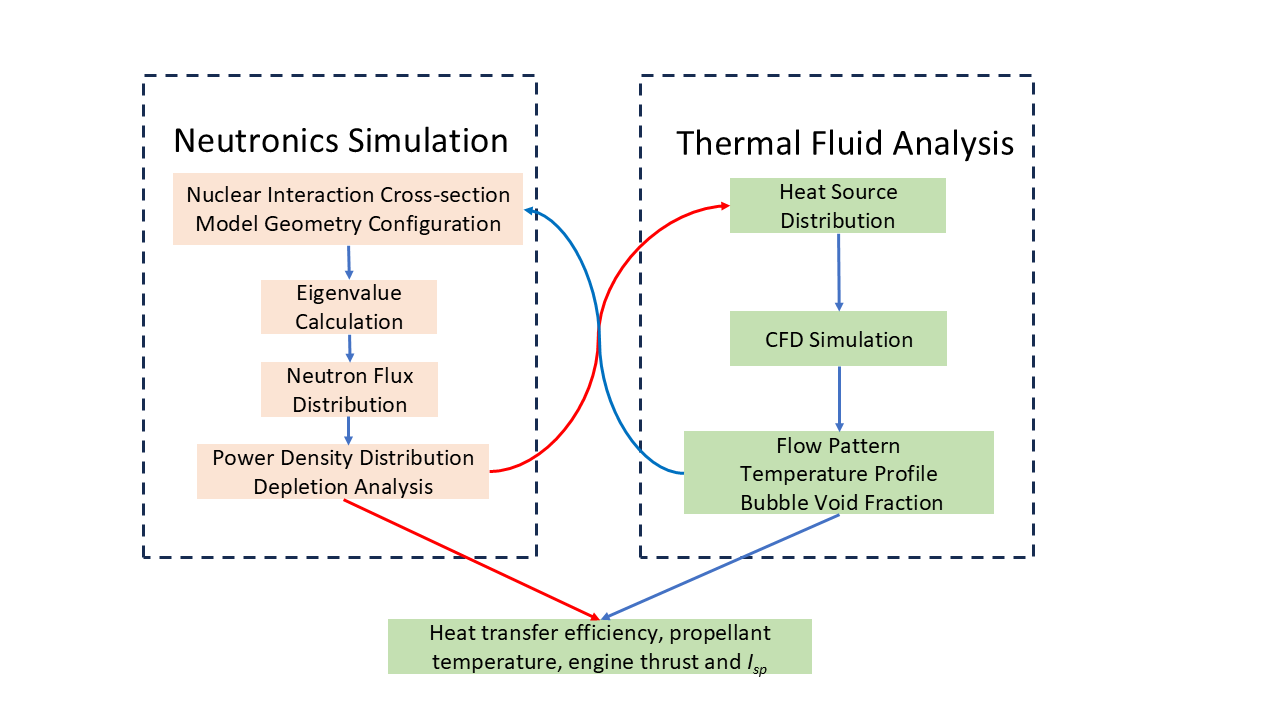
We are excited to announce our proposal, "Nexus of Neutronics-Thermal Fluid Analysis for Optimizing Centrifugal Nuclear Thermal Propulsion," has been selected for funding! As the Principal Investigator, Dr. Huang Chen will work with Dr. Yi-Tung Chen to conduct a preliminary optimization study of Centrifugal Nuclear Thermal Propulsion (CNTP) engines, examining both reactor physics and thermal-fluid dynamics. This one-year seed funding from NASA will help us understand how to maximize the performance of this promising propulsion system, which has the potential to bring humans to the solar system and beyond.
This project is focused on conducting a preliminary optimization study of Centrifugal Nuclear Thermal Propulsion (CNTP) engines, examining both reactor physics and thermal-fluid dynamics. The next chapter of human space exploration to our solar system and beyond requires highly efficient propulsion systems. Among various designs, fission nuclear thermal propulsion (NTP) stands out for its high thrust and high specific impulse (Isp).
Recently, the global consent to nuclear non-proliferation and the Comprehensive Nuclear-Test-Ban Treaty (CTBT) pivoted away from using high-enrichment uranium (HEU) in nuclear reactor cores. This shift promotes the adoption of High Assay Low Enriched Uranium (HALEU) fuel across nuclear reactor designs. With HEU no longer a viable option, increasing the temperature gradient is the key to improve Isp. As such, CNTP with a liquid core design has gained significant attention from NASA.
CNTP uses an array of fast-spinning cylinders that confine high-temperature molten uranium. When propellant is injected into the molten fuel as bubbles, a temperature of over 5,000K can be achieved. The extremely hot propellant helps the engine to reach an impressive Isp of 1,800s, tripling that of the most efficient chemical propulsion system.